FCPS Part II in Diagnostic Radiology is the exit examination of the College of Physicians and Surgeons Pakistan (CPSP) fellowship. It is a big syllabus that covers every organ system and every modality. The residents who pass first time are rarely the ones who read the most. They are the ones who read selectively, practise questions daily and review their mistakes. This guide shows you how to do that.
The FCPS radiology pathway at a glance
The CPSP Diagnostic Radiology fellowship takes four years of supervised training. It has three examination stages:
| Stage | When | What it involves |
|---|---|---|
| FCPS Part I | Before entering training | Basic sciences entry exam, after MBBS and house job |
| IMM (Intermediate Module) | After 2 years of training | Mid-training exam; mandatory CPSP workshops must be completed first |
| FCPS Part II | After 2 further years of advanced training | Exit exam: theory, then TOACS and viva |
The current CPSP curriculum says residents may continue into advanced training before sitting IMM, but IMM must be passed before the FCPS Part II exit exam. For residents inducted from January 2025 onwards, the curriculum also requires evidence of one research paper published in a CPSP-approved journal to sit the final exam. Start your synopsis early.
Revising for IMM? Our free 587 IMM radiology flashcards cover anatomy, physics, signs and syndromes.
What the FCPS Part II Radiology exam involves
1. Theory: two BCQ papers
The theory component has two papers in best choice question (BCQ) format: a clinical vignette and four or five options, with one best answer. You must pass the theory before you can sit the clinical component. BCQs reward exactly the kind of knowledge found in review manuals: the classic sign, the commonest cause, the discriminating feature between two look-alike lesions, and the next best investigation.
2. TOACS
The Task Oriented Assessment of Clinical Skills (TOACS) is image-based and computer-based, with stations covering all modalities: plain films, ultrasound, CT, MRI, fluoroscopy and nuclear medicine. Each station shows images and asks you to identify findings, give a diagnosis or differential, or choose the next step.
3. Viva
The viva is organised by system, with different examiners covering different body systems. Expect to be shown cases and asked to describe, interpret and manage them aloud.
Best books for FCPS Part II Radiology
You do not need ten textbooks. You need one review manual that you know very well, one reference book for understanding, and thousands of practice questions.
- Dähnert, Radiology Review Manual: the classic list-based review book. Differentials, signs and key facts in a compact format that maps directly onto BCQs. Use it as your core revision text.
- Grainger & Allison's Diagnostic Radiology: the comprehensive reference. Read chapters for topics you don't understand, rather than cover to cover.
- Brant & Helms, Fundamentals of Diagnostic Radiology: clear explanations, useful in the first year or for weak systems.
- Radiopaedia.org: free cases and articles. It is excellent for TOACS practice because you see real images, not just text.
- A large question bank: this is where knowledge becomes exam performance (see below).
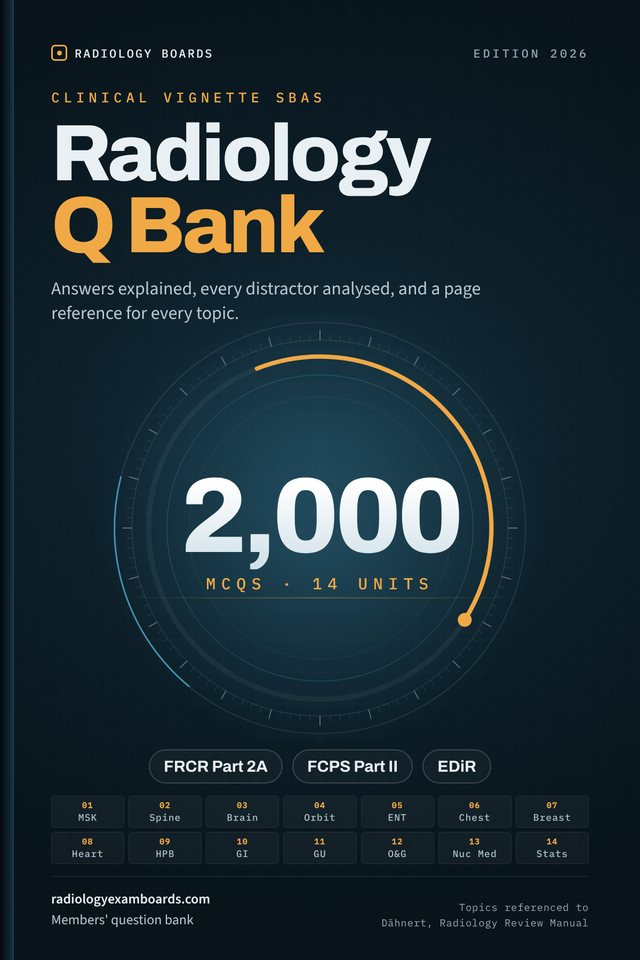
2,000 MCQs referenced to Dähnert
The Radiology Q Bank turns the review manual into clinical vignette questions across 14 units. Every answer is explained, with why each wrong option is wrong and a page reference.
Try 10 questions freeA 12-week FCPS Part II study plan
This plan assumes 2–3 hours on weekdays and longer sessions at weekends, alongside your rotation. Each week, read the system in Dähnert, then do every question for that unit and review the explanations the same day. The "Q bank" column refers to the units in the Radiology Q Bank.
| Week | System | Q bank | High-yield focus |
|---|---|---|---|
| 1 | Chest | Unit 6 | Airspace vs interstitial patterns, nodules, ILD, mediastinal masses |
| 2 | Cardiac & vascular | Unit 8 | Congenital heart disease, cardiac MRI basics, aortic disease |
| 3 | GI tract | Unit 10 | Barium signs, bowel obstruction, IBD, GI tumours |
| 4 | Liver, biliary, pancreas, spleen | Unit 9 | Focal liver lesions, biliary disease, pancreatitis |
| 5 | Genitourinary & adrenal | Unit 11 | Renal masses, Bosniak, adrenal adenoma, urinary tract |
| 6 | Obstetrics & gynaecology | Unit 12 | Early pregnancy, fetal anomalies, adnexal masses |
| 7 | Breast | Unit 7 | BI-RADS, calcifications, spiculated lesions, MRI |
| 8 | Brain | Unit 3 | Stroke, tumours, white matter disease, paediatric neuro |
| 9 | Spine, orbit, head & neck | Units 2, 4, 5 | Spinal cord lesions, orbital masses, sinonasal, neck spaces |
| 10 | Musculoskeletal | Unit 1 | Bone tumours, arthritis, trauma, metabolic bone disease |
| 11 | Nuclear medicine, statistics & contrast | Units 13, 14 | Radiopharmaceuticals, test statistics, contrast reactions |
| 12 | Mock papers & weak areas | Mixed | Timed mixed blocks; re-attempt every question you got wrong |
Two habits make this plan work:
- Keep an error log. For every question you get wrong, write one line about the fact you were missing. In the last two weeks, revise from the log rather than the textbook.
- Use flashcards for lists. Spend ten minutes a day on spaced repetition for signs, classifications and numbers. Our free FCPS radiology flashcards and FRCR rapid review are built for this.
How to answer radiology BCQs
- Read the last line first. Know whether you are being asked for the diagnosis, the next investigation or the most likely complication before you read the vignette.
- Underline the discriminators. Age, sex, the modality and a single key sign usually decide the answer. "Fat-containing", "target sign" or "restricted diffusion" should trigger a short differential straight away.
- Answer before you look at the options. Then find your answer among them. This stops plausible distractors from pulling you off course.
- Choose the best, not just a true, answer. Several options may be correct statements. Pick the most specific or most common one for this scenario.
- Review every explanation, even when you were right. Knowing why options B, C and D are wrong is what lets you answer the next, slightly different question.
Try a sample question
A 59-year-old woman undergoes diagnostic mammography at the breast clinic. How does a radial scar typically appear?
- A dense central mass with short spicules ("white star")
- A "black star": long thin radiating spicules with a lucent centre, varying in appearance between projections
- Coarse popcorn calcification
- A well-circumscribed oval mass
Show answer
B. A radial scar (complex sclerosing lesion) has a radiolucent centre with long spicules. Carcinoma typically has a dense central mass (the "white star", option A). Popcorn calcification (C) suggests a degenerating fibroadenoma, and a circumscribed oval mass (D) suggests a fibroadenoma or cyst. Excision is generally recommended because a radial scar can harbour or mimic carcinoma.
TOACS and viva tips
- Look at images every day. Text knowledge alone will not get you through TOACS. Review 10–20 cases a day from your department's teaching files or Radiopaedia, and name the modality, sequence and plane before the diagnosis.
- Use a fixed system for describing images. Modality, area, the key abnormality, then supporting features, differential and next step. Practise saying it aloud with a colleague.
- Know your "aunt Minnies". Classic, instantly recognisable appearances come up repeatedly. Flashcards of signs are ideal here.
- In the viva, start with the most likely diagnosis, then give a short differential. If you don't know, describe what you see clearly; examiners reward a systematic approach.
Common mistakes to avoid
- Reading large textbooks cover to cover in the last three months instead of doing questions.
- Doing questions without reading the explanations.
- Leaving physics, statistics and contrast media to the last week. They are short topics and easy marks.
- Ignoring the research publication requirement until it delays your exam eligibility.
- Never sitting a timed mock paper before the real exam.
Frequently asked questions
How long is FCPS training in Diagnostic Radiology?
The CPSP fellowship in Diagnostic Radiology is four years: a two-year Intermediate Module (IMM) followed by two years of advanced training, ending with the FCPS Part II exit examination.
What is the format of the FCPS Part II Radiology exam?
The exam has a theory component of two papers in best choice question (BCQ) format, which must be passed first. Candidates who pass then sit the clinical component: an image-based, computer-based TOACS covering all imaging modalities, and a system-wise viva. Always confirm the current format, dates and fees on the CPSP website before you apply.
Is Dahnert enough for FCPS Part II?
Dahnert's Radiology Review Manual is one of the most useful books for the theory papers because it is list-based and covers the high-yield facts, differentials and signs that BCQs test. Most candidates pair it with a fuller textbook such as Grainger & Allison's Diagnostic Radiology for understanding, and with a large bank of practice questions.
How many MCQs should I solve before FCPS Part II?
There is no official number, but aim to work through at least one complete question bank of around 2,000 questions, and to review every explanation, including why the wrong options are wrong. Re-attempt the questions you got wrong in the final four weeks.
Can I use FRCR 2A resources for FCPS Part II?
Yes. FRCR 2A and FCPS Part II theory both test core radiology knowledge with single best answer style questions, so FRCR 2A question banks and rapid-review notes overlap heavily. Check local CPSP emphasis, such as physics, anatomy and locally common conditions, as well.
Is there a free radiology question bank for FCPS?
Radiology Boards offers free questions to try: 10 questions from the 2,000-question Dahnert Radiology Q Bank, free questions in the main question bank, and over 1,000 free flashcards for FCPS, IMM and FRCR revision.
Start practising today
Try free questions from both question banks, then get full access to every question for PKR 10,000 (US$50) a year.
Try the Dahnert Q bank free See pricing